Sepilok | Turtle Island | Lankayan Island | Libaran Island |Berhala Island |Gomantong Cave | Sukau | Batu Tulug|


SEPILOK ORANG UTAN
REHABILITATION CENTRE

A dream for anyone interested in wildlife. You will experience several of the world's most unique and facinating arears. A visit to Sepilok Orang Utan Sanctuary will allow you yo come in close contact with remarkable "man of the forest". It is interesting and exciting to watch as these red apes, man's closest relatice, are astonishing gentle, highly intelligent and will gaze at you with almost disconcerting fankness.
Only 28 kilometres from Sandakan town, and set in 43 square kilometres of beautiful virgin forest, the Sanctuary was begun in 1964 to help once captive orang utan learn to fend for themselves in the wild. These large red apes - man's closest relative are astonishingly gentle and highly intelligent, gazing at visitors with almost disconcerting frankness. To avoid the spread of disease, touching the animals is not permitted inside the Sanctuary.
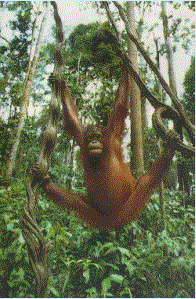
However , it is usually possible to meet and photograph a couple of the mature females, who are so fond of human company that they refuse to go back to the wild, just outside the Registration Centre. After watching orphaned orang utan being taught how to climb, visitors then go to a platform where they can watch the semi-wild orang utan come in from the further reachers of the forest for their twice-daily ration of milk and bananas. The Sanctuary also houses a couple of highly endangered Sumatran rhinos, and occasionally other animals such as elephants. These is an Informations Nature Education Centre, and a mini-theatre where a documentary video on the work of the Sepilok Orang Utan Sanctuary is shown.
top


SELINGAN TURTLE ISLAND
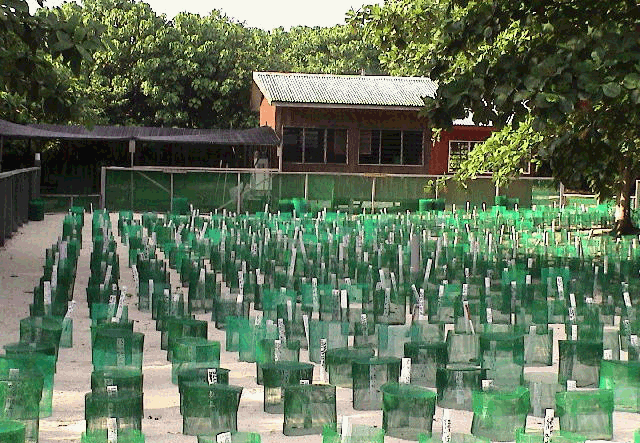
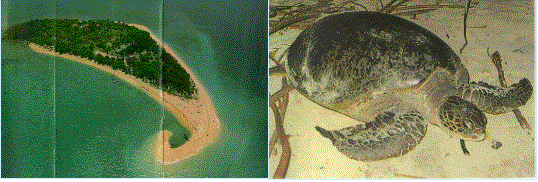
The Turtle Islands Park lies 40km north of Sandakan in the Sulu Sea off Sabah's east coast. It encompassess 1,740 hectares which includes the three islands of Pulau Selingan, Pulau Bankungan Kecil and Pulau Gulisan; the sea and surrounding coral reef.
The islands are built over shallowrocky shoals from coral shingle from the surrounding reef on the fringes. They are covered with a variety of plant life which includes mangrove, lantana, the yellow-flowered sophora and the furry silver-leaved Tournefortia. The main attractions here, however, are the turtle which come to nest on their shores. Pulau Selingan is the main nesting area for the green turtles chelonia mydas, while the hawksbill turtle Eretmochelys seem particularly attracted to the shore of Pulau Gulisan. Both species lay their eggs on these shores throught the year, althought the best months are between July to October. The islands are gazetted as Marine Parks in 1977 primarily for the protection of these two species in order to save them from extinction.
The park is located 2 hours by boat and 40km from Sandakan town on Sabah east coast and the first in a chain of small island that strecth accross the Sulu Sea to the Philippine.
top

LIBARAN ISLAND

Libaran Island is just next to Selingan Turtle Island. Is is the ideal jump off point to see the turtle at Selingan Islan. From the island, one can have excellent view of the sea. Alternatively, snorkelling trips, boat trips to the mangrove forest, jungle tracking at nearby island to see wildlife, village walk and night fishing can easily arranged.
top

BERHALA ISLAND

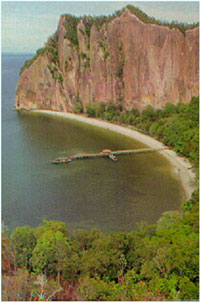
Just 15 minutes by boat from the town of Sandakan lies Pulau Berhala. Its most striking feature is the awesome dusky-pink range of cliffs that drops perpendicularly into the waters. Blessed with fine white sand and clear wters, the island is set to become a major tourist destination. The rock cliff provides great potential for Eco-challenge rock climbing events. Boats to the island are available at the Sandakan market place or by pre arrangement.
top

LANKAYAN ISLAND

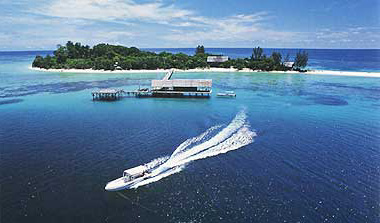
A tiny speck in the Sulu Sea offers a little known island paradise. Lankayan Island boats of beatiful white sand beaches, pristine corals, excellent wrecks and an endless suplly of muck diving opportunities. A two-hour boat ride from Sandakan Sabah, Lankayan Island has only recently been inhabited to service dive tourism. Set up in conjunction with the government of Sabah to concerve and promote the area as a tourist attraction, the surrounding waters have been officially declared a marine reserve, ensuring the protection of island's growing fish and nesting turtle population. For diving enthuasiates, this is another great diving spot which is comparable to the Wolds' famous Sipadan Island.
top

GOMANTONG CAVE

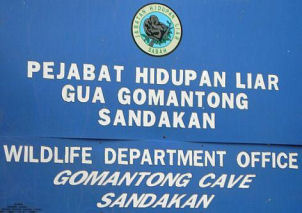
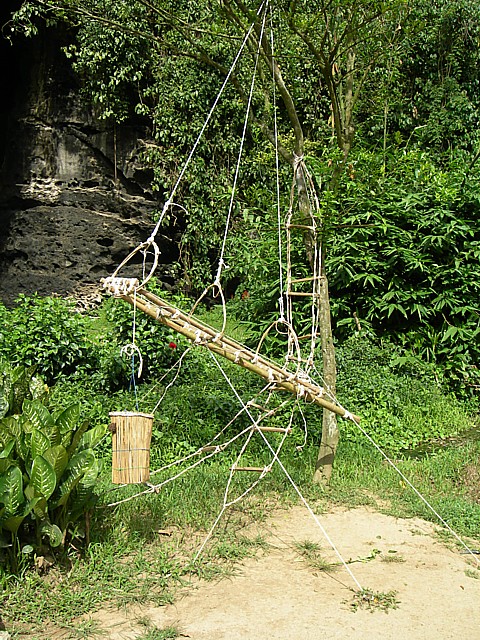
The Gomantong Caves are an intricate limestone cave system of Gomantong Hill. Situated in the eastern lowlands of Sabah, in the district of Sandakan. The Gomantong Caves are well known for their birds' nest industry. The local people are collecting these nests using bamboo ladders and poles.

The caves are open all year daily.
If you're coming from Lahad Datu or Sandakan, take turnoff towards at Sukau for about 20 kilometres to the main entrance of the caves. From here it is another 6 km to the base of the caves and reception area. There are board walked trails to the lower caves. The trails to the upper caves are well-used, but should only be visited with a guide.

The Gomantong Cave (southwest of Sandakan) is divided into two caves: the Simud Hitam and the Simud Putih.
Swiftlets, who make the valuable nests, and bats share the caves with thousands of insects which live in the rich guano on the floor.

The Simud Hitam (Black Nest Cave) is the more accessible.
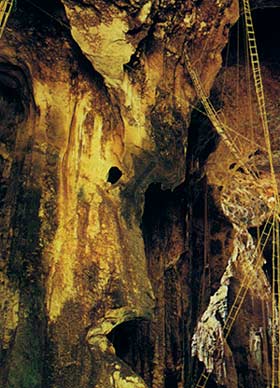
It has a huge grotto-like opening with a circular boardwalk to keep you off the guano-covered ground crawling with bugs and cockroaches. This cave is just a 5 minutes walk from the Registration Centre. It has a large chamber 30 m wide and 100 m high.

The swiftlets produce the 'black' nests. The nests are made of the swiftlets' hardened saliva mixed with feathers.
The Simud Putih is larger (White Nest Cave) and less accessible. It's located on a limestone cliff above the Simud Hitam. This is the cave, where the valuable white birds’ nest is harvested, made of pure saliva. For centuries the birds nest harvested here and formed an important source of supplies to China where it had been and still is, a prized delicacy.

Harvesting is now regulated by the Wildlife Department to avoid over-exploitation, which only allows the collection twice yearly.
Twice a year, licensed collectors gather the nests in a dangerous operation.

The collectors are climbing to the roof of these cave complexes in a dangerous operation using only rattan ladders, ropes and poles precariously attached together.

The nests are first harvested just after the birds have made them (between February and April).
The birds then build new nests, which are left undisturbed until after the eggs have been laid and hatched; these nests are then gathered, some time between July and September. The nests can be worth a US$500 per kilo.

Stay the evening (around 5.15 pm) and witness a spectacular aerial show as millions of bats pour out of this opening for their nightly forage of insects. At the same time, the swiftlets will be returning to roost in the darkness of the cave. This soup of “meals in flight” is the perfect opportunity for predator birds such as serpent eagles and kites to drop by for dinner.

The WWF described the Gomantong Cave as "the best managed edible birds' nest cave in the world"
The locals recover the bird nests and made it a local delicacy: the bird nest soup. I tried a bird nest drink a few days later and it was quite nice actually. It tasted like vanilla banana with stringy noodles (which are the pieces of the nest).

top